
Hey there! As a table lift supplier, I often get asked about the differences between scissor table lifts and vertical table lifts. It's a common question, and understandably so, as both types of lifts are used for similar purposes but have distinct features. In this blog, I'll break down the key differences to help you make an informed decision when it comes to choosing the right lift for your needs.
Design and Structure
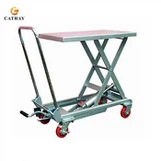
Let's start with the design. A scissor table lift, as the name suggests, uses a scissor - like mechanism. The criss - cross support structure expands and contracts to raise and lower the platform. This design allows for a large amount of vertical movement in a relatively compact footprint when the lift is in its retracted state. You can check out our Single Scissor Lift to get a better idea of how this mechanism works.
On the other hand, a vertical table lift typically has a more straightforward design. It uses a vertical guide system, often with hydraulic cylinders or a screw - driven mechanism, to move the platform up and down. This design provides a more direct vertical movement, and it's generally more stable for lighter loads and when precise positioning is required.
Lifting Capacity
When it comes to lifting capacity, scissor table lifts usually have an edge. The scissor mechanism is designed to distribute the weight evenly across the structure, allowing it to handle heavier loads. Depending on the model, scissor lifts can lift anywhere from a few hundred pounds to several tons. Our Hydraulic Lift Machine is a great example of a high - capacity scissor lift that can handle substantial loads with ease.
Vertical table lifts, while they can also be quite strong, are often better suited for lighter to medium - weight loads. Their design is optimized for precision rather than sheer brute force. So, if you're dealing with heavy machinery or large pallets, a scissor lift might be the way to go. But if you're working with smaller, more delicate items, a vertical lift could be more appropriate.
Height Range
The height range is another important factor to consider. Scissor table lifts can achieve a relatively large vertical travel. They can reach heights of up to 20 feet or more, depending on the number of scissor sections and the design of the lift. This makes them ideal for applications where you need to access high shelves or work at elevated heights.
Vertical table lifts, however, usually have a more limited height range. They are typically used for shorter vertical distances, often up to 10 feet. This is because their design is more focused on providing a stable and precise lift over a shorter distance. If you only need to lift items a few feet off the ground, a vertical lift can be a more cost - effective and space - saving option.
Mobility and Portability
Mobility is something that varies between the two types of lifts. Scissor table lifts can be either stationary or mobile. Mobile scissor lifts are equipped with wheels, which allows them to be moved around the workspace easily. This makes them very versatile, as you can use them in different locations within a warehouse or factory.
Vertical table lifts are often more stationary. They are usually bolted down to the floor to ensure stability during operation. While some models may have limited mobility options, they are generally not as easy to move around as scissor lifts. So, if you need a lift that you can move from one place to another frequently, a mobile scissor lift might be a better choice.
Safety Features
Both scissor table lifts and vertical table lifts come with a range of safety features. Scissor lifts typically have safety bars or guards around the platform to prevent objects or people from falling off. They also often have overload protection systems to prevent the lift from being overloaded, which can cause damage to the lift or pose a safety risk.


Vertical table lifts also have their own set of safety features. They usually have limit switches that stop the lift at the maximum and minimum heights to prevent over - travel. Additionally, some vertical lifts are equipped with anti - fall devices to ensure the safety of the operators and the load.
Cost
Cost is always a consideration when purchasing a table lift. Generally speaking, scissor table lifts tend to be more expensive, especially for high - capacity and high - reach models. This is due to their more complex design and the materials used in their construction.
Vertical table lifts are often more budget - friendly, especially for smaller models with lower lifting capacities. If you're on a tight budget and only need a lift for light - duty applications, a vertical lift could be a great option.
Applications
The applications for scissor table lifts and vertical table lifts also differ. Scissor lifts are commonly used in warehouses for loading and unloading pallets, in manufacturing plants for assembling large equipment, and in construction sites for accessing elevated work areas. For example, our Scaffold Lift is a type of scissor lift that is specifically designed for construction and maintenance work at height.
Vertical table lifts are often used in laboratories for handling delicate equipment, in retail stores for stocking shelves at a lower height, and in small workshops for lifting and positioning small parts. They are ideal for applications where precision and stability are key.
Conclusion
In conclusion, the choice between a scissor table lift and a vertical table lift depends on your specific needs. If you need to lift heavy loads to a great height, move the lift around frequently, and have a larger budget, a scissor lift is probably the best option. On the other hand, if you're dealing with lighter loads, need precise positioning, and have a limited height requirement, a vertical lift could be the way to go.
If you're still not sure which type of lift is right for you, or if you have any questions about our products, don't hesitate to get in touch. We're here to help you find the perfect table lift for your business. Whether it's for a small - scale operation or a large industrial facility, we've got the expertise and the products to meet your needs. Contact us today to start the procurement process and let's find the ideal table lift for you.
References
- Industry standards and guidelines for table lifts
- Manufacturer's specifications for scissor and vertical table lifts