
A floor crane is an indispensable piece of equipment in various industrial and commercial settings, offering flexibility and efficiency in lifting and moving heavy loads. As a floor crane supplier, I've had the privilege of closely examining and understanding the intricate components that make up these remarkable machines. In this blog post, I'll delve into the main components of a floor crane, shedding light on their functions and importance.


Base and Wheels
The base of a floor crane serves as its foundation, providing stability and support during operation. It is typically made of heavy - duty steel to withstand the weight of the loads being lifted. The design of the base is crucial; it needs to be wide enough to prevent the crane from tipping over while remaining compact enough to maneuver in confined spaces.
Wheels are attached to the base, enabling the crane to be moved easily. There are different types of wheels used in floor cranes. Fixed wheels provide stability in a straight - line movement, while swivel wheels allow for greater maneuverability, especially when the crane needs to change directions. Some floor cranes are equipped with locking mechanisms on the wheels to secure the crane in place during lifting operations. For example, in a busy warehouse where the crane needs to be repositioned frequently, having a combination of fixed and swivel wheels with reliable locking systems can significantly improve efficiency.
Mast
The mast is the vertical structure of the floor crane that supports the boom and other lifting components. It is usually constructed from high - strength steel to handle the bending and compressive forces exerted during lifting. The mast needs to be rigid enough to prevent excessive deflection, which could affect the accuracy of the lift and pose a safety risk.
In some floor cranes, the mast may be telescopic, allowing for adjustable height. This feature is particularly useful in applications where the lifting height needs to be changed according to the task at hand. For instance, in a manufacturing plant where different sized products are being handled, a telescopic mast can provide the flexibility to lift loads to various heights without the need for multiple cranes.
Boom
The boom is the horizontal or angled arm of the floor crane that extends from the mast. It is responsible for reaching out to the load and positioning it accurately. The length of the boom can vary depending on the model and application requirements. Longer booms provide greater reach but may also reduce the lifting capacity due to the increased leverage.
The boom can be either fixed or adjustable. An adjustable boom can be raised or lowered, as well as extended or retracted, offering more versatility in lifting operations. For example, in a construction site where materials need to be placed at different distances and heights, an adjustable boom can be adjusted to the optimal position for each lift. Some advanced floor cranes also feature a telescopic boom, which can further increase the reach and flexibility of the crane.
Hoist
The hoist is the component that actually lifts and lowers the load. It consists of a motor, a drum, and a cable or chain. The motor provides the power to drive the drum, which winds or unwinds the cable or chain to lift or lower the load.
There are different types of hoists available for floor cranes. Manual hoists are operated by hand, usually using a chain or lever. They are suitable for light - duty applications where the lifting capacity is relatively low and the frequency of use is not high. Electric hoists, on the other hand, are powered by electricity and offer greater lifting capacity and higher speed. They are commonly used in industrial settings where heavy loads need to be lifted frequently. For more information on electric - powered hoists, you can check out our Electric Powered Floor Crane.
Controls
The controls of a floor crane are essential for safe and efficient operation. They allow the operator to control the movement of the crane, including the lifting, lowering, and horizontal movement of the boom. Modern floor cranes are equipped with a variety of control systems, ranging from simple manual controls to advanced electronic controls.
Manual controls typically consist of levers or handwheels that the operator uses to operate the hoist and move the crane. They are straightforward and easy to understand, but may require more physical effort from the operator. Electronic controls, on the other hand, use sensors and actuators to control the movement of the crane. They offer more precise control, better safety features, and can be programmed for specific lifting tasks. For example, in an automated warehouse, electronic controls can be integrated with the warehouse management system to optimize the lifting and movement of goods.
Counterweight
Counterweights are used to balance the load being lifted by the floor crane. They are usually located at the rear of the crane's base. The purpose of the counterweight is to prevent the crane from tipping forward when a heavy load is lifted at the end of the boom.
The amount of counterweight required depends on the lifting capacity and the reach of the crane. A larger counterweight is needed for cranes with longer booms and higher lifting capacities. In some cases, the counterweight may be adjustable, allowing for fine - tuning according to the specific lifting requirements. This ensures that the crane remains stable and safe during operation.
Power Source
Floor cranes can be powered by different sources, including manual, electric, and hydraulic. Manual floor cranes rely on human effort to operate the hoist and move the crane. They are simple, cost - effective, and suitable for light - duty applications. However, they are limited in terms of lifting capacity and speed.
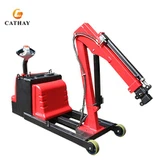
Electric floor cranes are powered by electricity and offer higher lifting capacities and faster operation. They are more convenient to use as they do not require physical exertion from the operator. Electric floor cranes can be either corded or battery - powered. Corded electric cranes provide a continuous power supply but are limited by the length of the power cord. Battery - powered electric cranes offer greater mobility but may require recharging. Our Electric Mobile Floor Crane is a great example of a battery - powered electric floor crane that combines mobility and power.
Hydraulic floor cranes use hydraulic fluid to generate the force needed for lifting and moving. Hydraulic systems offer smooth and precise operation, high lifting capacities, and are suitable for heavy - duty applications. They are often used in industries such as construction and mining.
Safety Features
Safety is of utmost importance in floor crane operation. Modern floor cranes are equipped with a range of safety features to protect the operator and the surrounding environment. Some common safety features include overload protection, which prevents the crane from lifting loads that exceed its rated capacity. This is usually achieved through sensors that detect the load and automatically stop the hoist if the limit is reached.
Emergency stop buttons are also standard on floor cranes. They allow the operator to immediately stop all crane operations in case of an emergency. Additionally, some cranes are equipped with anti - collision devices, which use sensors to detect obstacles in the crane's path and prevent collisions.
Accessories
In addition to the main components, floor cranes can be equipped with various accessories to enhance their functionality. For example, a jib attachment can be added to the boom to provide additional reach and flexibility. A Mini Mobile Slewing Jib Crane can be a useful accessory for applications where precise positioning of small loads is required.
Other accessories may include hooks, slings, and lifting magnets, which are used to secure and lift different types of loads. These accessories need to be selected carefully according to the nature of the load and the lifting requirements.
As a floor crane supplier, we understand the importance of providing high - quality components and reliable equipment. Whether you are looking for a floor crane for a small workshop or a large industrial facility, we have the expertise and products to meet your needs. If you are interested in learning more about our floor cranes or would like to discuss your specific requirements, please feel free to contact us for a detailed consultation and procurement discussion.
References
- Crane Manufacturers Association of America (CMAA). Crane Standards and Guidelines.
- Occupational Safety and Health Administration (OSHA). Safety Regulations for Crane Operations.
- Machinery's Handbook, 31st Edition. Industrial Press Inc.