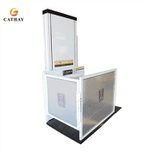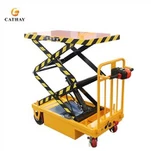


Have you done the preparations before using the hydraulic self propelled scissor lift?
Preparatory Work Before Using Hydraulic Self Propelled Scissor Lift
Working at heights always involves certain risks and safety concerns that must be addressed to ensure the safety of workers. The use of hydraulic self propelled scissor lifts is becoming increasingly popular for working at heights due to their mobility and stability. However, before using hydraulic self propelled scissor lifts, there are certain preparatory works that must be done to ensure the safety of the workers and the environment.

Safety Gear and Clothing:working at height involves some level of risk, and it is crucial to ensure that the workers use the right safety gear and clothing. The operator must wear a safety belt that meets the safety requirements and wear neat clothes. Hard-soled or spiked, slippery shoes should be avoided. The job site must be supervised by a guardian, and no unrelated personnel are allowed to enter the site. Special workplaces that do not have the conditions for using seat belts must take safety measures and be supervised by someone.
Health Status: Workers with certain medical conditions are not suitable for working at heights. Therefore, it is necessary to check the health status of the workers before assigning them to work at heights. Anyone who suffers from high blood pressure, heart disease, anemia, epilepsy, and other conditions that are not suitable for working at heights shall not engage in working at heights.
Weather Conditions: Weather conditions can also affect the safety of workers at height. In case of severe weather, such as wind force above level 6, lightning, etc., that affects construction safety, open-air high-altitude operations are prohibited.
Electrical Safety: When working with electrical equipment, workers must adhere to the relevant regulations issued by the labor department.
Ladder Safety: Ladders are commonly used for accessing heights. However, certain safety measures must be taken when using ladders:
(1) The ladder must not be short of rungs, and the distance between the rungs of the ladder should be 30dhl.
(2) It is forbidden to use the ladder on a higher or extended length. When using it, the upper end should be fastened firmly, and the lower end should have non-slip feet. The angle between the single-sided ladder and the ground should be 60-70°. It is advisable that the included angle of the ladder is about 40±5°, and there is a reliable span-limiting device.
(3) It is forbidden for two people to work on the ladder at the same time.
(4) Ladders must meet the safety requirements. Ladders without gears, non-slip feet, and span limit devices are prohibited from being used.
Roof Safety: It is forbidden to walk on roof trusses, beams, and unfixed objects, and it is forbidden to use containers containing flammable and explosive materials to climb high. Safety measures must be taken when working on the roof of asbestos tiles or other lightweight materials, and it is strictly forbidden to step on it directly.
Platform and Stool Safety: Platforms and stools exceeding two meters should be equipped with guardrails. For a platform built with a flat plate, the flat plate must be fastened firmly to prevent the probe board from tipping over. The width of the springboard used for single passages shall not be less than 0.6 meters, and for double passages shall not be less than 1.2 meters, and the slope shall not be greater than 1:3.
Cargo Elevator and Hanging Basket Safety :For cargo elevators or hanging baskets, it is forbidden for people to ride, and it is forbidden for people to climb up and down the boom, ropes, hanging baskets, and hanging objects accompanying materials.

For more information about the hydraulic self propelled scissor lift, welcome to contact us.
Shandong Cathay Machinery Co., Ltd
www.cathaylift.com
Email:sales@cathaylift.com