

As mobile elevated work platforms (MEWPs) continue to evolve, pull‑behind bucket lifts (also known as trailer boom lifts) have become indispensable across construction, property management, municipal maintenance, and facility services. Combining mobility, affordability, and reliable performance, these towable aerial solutions support efficient, safe elevated work while lowering total operational costs. This industry guide covers core knowledge to help users select, operate, and maintain pull‑behind bucket lifts for maximum value and compliance.
What Are Pull‑Behind Bucket Lifts?
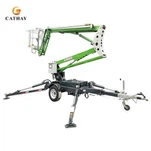
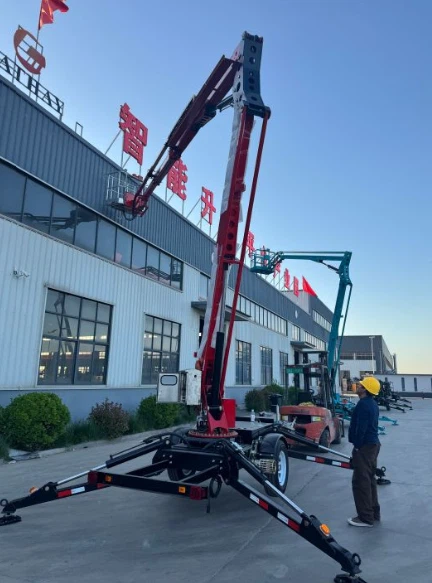
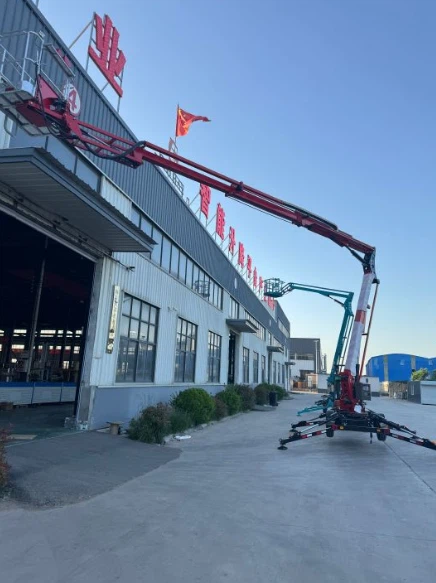
Pull‑behind bucket lifts are compact, trailer‑mounted aerial platforms designed for light to medium‑duty elevated tasks. Towed by pickup trucks, vans, or light commercial vehicles without requiring a special license, they feature hydraulic telescopic or articulated booms, self‑leveling outriggers, and multi‑power compatibility. Typical working heights range from 10m to 24m, with load capacities around 227kg, suiting single‑operator jobs with tools and materials. Key advantages include fast setup, low fuel/energy use, gentle ground pressure for lawns and sensitive surfaces, and flexible indoor/outdoor deployment.
Core Classifications & Structural Advantages
Pull‑behind lifts fall into two main boom types, each optimized for different scenarios:
Telescopic boom: Straight, extended reach for open areas; ideal for street lighting, exterior repairs, and overhead maintenance where maximum height and horizontal outreach matter.
Articulated boom: Jointed arm design for navigating obstacles in tight spaces; perfect for building facades, tree care, and indoor venues with columns or equipment.
Modern units include automatic self‑balancing outriggers, torsion‑shaft suspension, pneumatic rubber wheels, and 359° non‑continuous turntable rotation for stable positioning and smooth operation. Multi‑power options-AC, DC battery, diesel, gasoline, and hybrid-enable zero‑emission indoor use and heavy‑duty outdoor performance.
Key Selection Criteria for Buyers
- Working height & reach: Match maximum height and horizontal radius to job needs; allow 1–2m buffer for safety clearance.
- Load capacity: Confirm total weight (operator + tools + materials) stays under the rated limit, usually 227kg.
- Power type: Choose DC for indoor quiet/zero emission; AC for fixed power access; diesel/gas for remote outdoor tasks; hybrid for mixed environments.
- Terrain compatibility: Prioritize self‑leveling outriggers and torsion suspension for slopes, grass, or uneven ground.
- Compliance & certification: Look for CE, ANSI, or EN standards to meet regional safety requirements.
- Mobility & storage: Folded dimensions should suit towing and storage; prioritize lightweight designs for frequent transport.
Safe Operation: Industry Best Practices
Safe use is non‑negotiable in aerial work. Follow these universal guidelines:
- Operator certification: Only trained, certified personnel should operate the lift; refresh training regularly.
- Pre‑use inspection: Check hydraulics, controls, safety systems, tires, and outriggers before each shift.
- Outrigger protocol: Fully extend and level all outriggers; use pads on soft ground to prevent sinking.
- Load & wind rules: Never exceed rated capacity; avoid operation in winds above level 5.
- Electrical safety: Maintain safe distance from power lines; use insulated configurations near live circuits.
- Emergency readiness: Ensure platform and ground controls include emergency stop, manual lowering, and anti‑tilt protection.
- PPE requirement: Operators must wear harnesses, hard hats, and non‑slip footwear.
Industry Trends & Market Outlook
Demand for pull‑behind bucket lifts is rising globally due to urban infrastructure growth, rental fleet expansion, and stricter safety rules. Trends include:
- Smart controls: LCD touch panels, multi‑language support, remote operation, and real‑time parameter monitoring.
- Eco‑friendly power: Higher adoption of DC and hybrid systems to meet low‑carbon rules.
- Enhanced safety: Tilt sensors, anti‑pinch platforms, overload protection, and automatic fault diagnosis.
- Cost efficiency: Lower total cost of ownership vs. self‑propelled or truck‑mounted lifts, driving purchase demand.
For more information about the pull‑behind bucket lift, welcome to contact us.
Shandong Cathay Machinery Co., Ltd
www.cathaylift.com
Email: sales@cathaylift.com