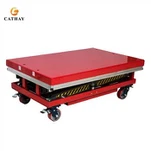


Understanding the Hydraulic Lifting Principle in Self-Propelled Scissor Lifts
Hydraulic lifts, such as the Self-Propelled Mobile Scissor Lift, operate on the principle of hydraulic transmission, which is renowned for providing stability and precision in lifting operations. This principle is fundamental in various industrial and residential applications, offering a reliable and efficient means of vertical movement.
At the core of hydraulic lifting is Pascal's Law, which states that when pressure is applied to a confined fluid, it is transmitted equally in all directions. In a hydraulic lift, this law is harnessed to generate substantial lifting force. The system typically consists of a hydraulic cylinder, a reservoir of hydraulic fluid, and a pump. When the pump activates, it pushes hydraulic fluid from the reservoir into the cylinder, creating pressure. This pressure forces the piston within the cylinder to extend, thereby raising the lift.
The precision and stability of hydraulic lifts come from the ability to control the fluid flow accurately. By regulating the amount of fluid entering the cylinder, operators can precisely control the lifting speed and height. This control is crucial in delicate environments where smooth and controlled movements are necessary to avoid damaging sensitive materials or structures.
Hydraulic lifts are also equipped with safety features such as pressure relief valves and flow control valves. Pressure relief valves prevent overloading by releasing excess pressure, while flow control valves ensure smooth and gradual movement by regulating the fluid flow. These features contribute to the overall safety and reliability of the lifting process.
One of the significant advantages of hydraulic lifts is their adaptability to various power sources. They can be powered by AC, DC, diesel, or gasoline engines, making them versatile for different site conditions. This power versatility ensures that hydraulic lifts can operate effectively in diverse environments, from industrial sites requiring robust and continuous lifting operations to residential projects needing quieter and more controlled movements.
In conclusion, the hydraulic lifting principle is a cornerstone of modern lifting technology, providing a stable, precise, and adaptable solution for vertical movement. Its application in self-propelled scissor lifts like the Self-Propelled Mobile Scissor Lift highlights its importance in achieving high standards of safety, reliability, and efficiency in both industrial and residential settings.

For more information about the Electric Car Mover Robot. Welcome to contact us.
Shandong Cathay Machinery Co., Ltd
www.cathaylift.com
Email:sales@cathaylift.com