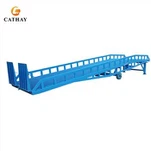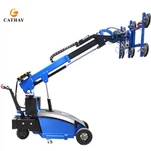


Several Hydraulic Valves are Commonly Used In Hydraulic Lifts, Aerial Work Platforms.
The use of elevators has been widely used in all walks of life. It can be seen in stations, docks, airports, hotels, municipal gardens, cleaning companies, decoration of public building facades, decoration or installation and maintenance of power systems, etc. Among them, hydraulic lifts are widely used, and they are replacement products for folding arm lifts and scissor lifts. But like this kind of high-altitude operation equipment, the safety requirements are very high, and some hydraulic valves should also be paid attention to when choosing a machine.

The hydraulic valve is an automatic component operated by pressure oil. It is controlled by the pressure oil of the pressure distribution valve. It is usually used in combination with the electromagnetic pressure distribution valve. It can be used to remotely control the on-off of the oil, gas, and water pipeline system of the hydropower station. Commonly used in clamping, control, lubrication, and other oil circuits. There are direct-acting and pilot-operated types, and the pilot-operated type is mostly used.
Hydraulic lifting platform products are divided into crank arm hydraulic lifts, scissor hydraulic lifts, mast hydraulic lifts, straight arm hydraulic lifts, etc. according to the working mode, and the hydraulic valves that are naturally configured are also different. Its working principle is that the hydraulic oil forms a certain pressure by the vane pump, and enters the lower end of the hydraulic cylinder through the oil filter, explosion-proof electromagnetic reversing valve, throttle valve, hydraulic control check valve, and balance valve so that the piston of the hydraulic cylinder moves upward. Movement, lifting heavy objects, the oil returned from the upper end of the hydraulic cylinder returns to the oil tank through the explosion-proof electromagnetic reversing valve, the rated pressure is adjusted through the overflow valve, and the reading value of the pressure gauge is observed through the pressure gauge.

The following are several common hydraulic valves for elevator equipment:
1. Manual or electromagnetic reversing valve, reversing valve, also known as Chris valve, can be adjusted in multiple directions, changing the fluid flow direction in time, and has a disc-type structure, which is mostly used in occasions with the small flow. When working, you only need to turn the handwheel to change the flow direction of the working fluid through the valve disc. A valve that can realize the communication, cut-off and reversing of hydraulic oil flow, as well as pressure unloading and sequential action control.
2. Overflow valve, which plays a role of safety protection in the system. When the system pressure exceeds the specified value, the safety valve will be opened to discharge part of the gas in the system into the atmosphere, so that the system pressure will not exceed the allowable value, so as to ensure that the system will not cause accidents due to excessive pressure. Pay attention to regular inspection and cleaning during use, and take reasonable measures to ensure the safety of the safety valve.
3. Throttle valve is a valve that controls fluid flow by changing the throttle section or throttle length. It is generally only used in occasions where the load changes little or the speed stability is not high. When the throttle valve has deposits, the engine will stall or the machine will not start, and the movement will be slow and the speed will increase suddenly, which will seriously affect the safety of high-altitude operations.
4. Balance valve, a valve with special functions. Its special feature lies in the difference between the use function and the place. In some industries, because the flowing material has a large pressure difference or flow difference in various parts of the pipeline or container, in order to reduce or balance the difference, valves are installed between the corresponding pipelines or containers to Adjust the relative balance of pressure on both sides, or achieve the balance of flow through the method of shunting.

Hydraulic Lifts and aerial work platforms are suitable for working at heights, so safety comes first. The various performances and accessories of the machine must be clearly understood. Various valve options need to be determined according to the lifting capacity, lifting speed, and working conditions of your hydraulic lift. The models of various valves produced by different manufacturers are not uniform, so if there is a problem with your hydraulic valve, please contact the manufacturer in time for repairs or contact Shandong Cathay Machinery Co., Ltd. Our technicians with more than 10 years of relevant work experience are ready to answer your questions or propose reasonable solutions to your aerial work-related projects.
Shandong Cathay Machinery Co., Ltd
Email:sales@cathaylift.com